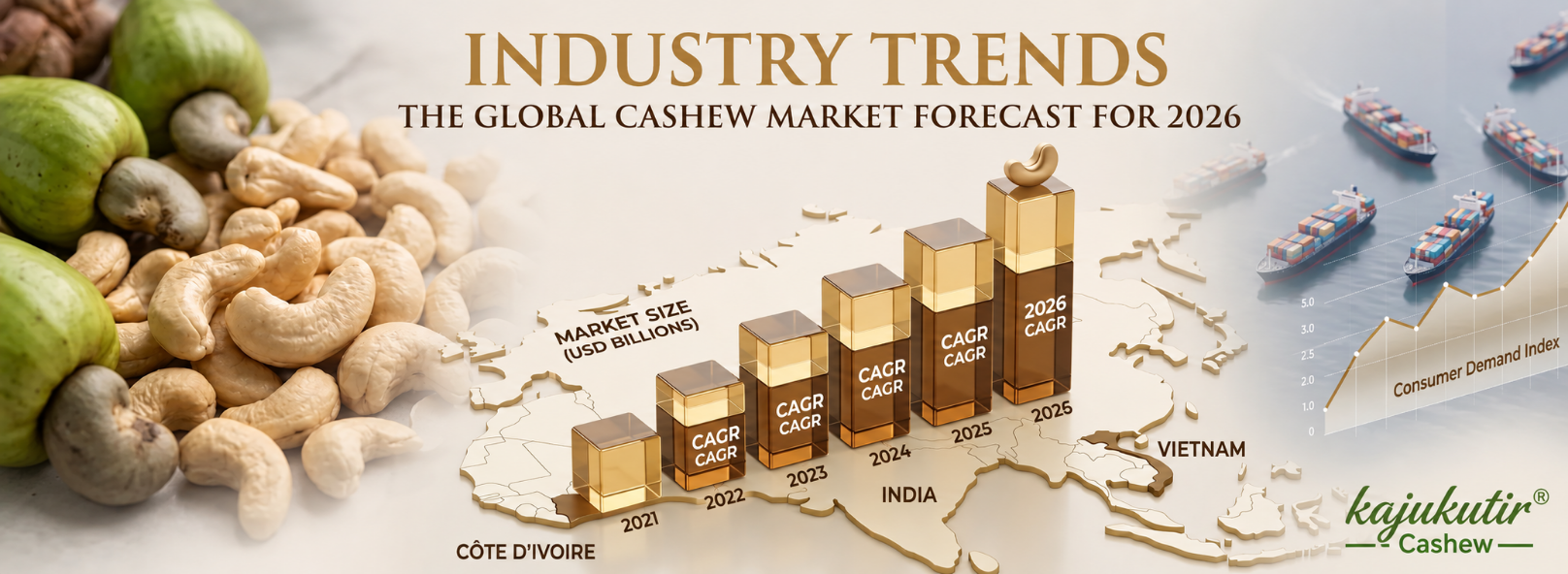
The global cashew industry is undergoing a remarkable transformation in 2026. As consumer preferences shift toward healthy, sustainable snacking options, cashew producers and processors are adapting to new market realities. This comprehensive analysis explores the key trends, challenges, and opportunities shaping the future of this billion-dollar industry.
From the farms of West Africa to the processing hubs in India and Vietnam, every link in the supply chain is evolving. Climate change impacts, technological advancements, and changing trade policies are creating both risks and opportunities for stakeholders across the value chain.
The cashew industry is at a pivotal moment. Those who invest in quality and sustainability will lead.
Market Overview 2026
The global cashew market has shown remarkable resilience in the face of global challenges. Raw cashew nut (RCN) prices have stabilized between $800-950 per metric ton, providing much-needed predictability for processors and traders. Processing capacity utilization has reached 78% globally, with India maintaining its position as the world's largest processor.
Export volumes have grown by 7.2% year-over-year, driven by strong demand from the Middle East, Europe, and North America. The United States remains the largest importer of processed cashews, followed by the European Union and China.
Key Market Drivers
1. Health & Wellness Trends
Consumers are increasingly aware of the health benefits of cashews, including heart health, weight management, and nutritional density. This has led to a 15% increase in per capita consumption in developed markets.
2. Product Innovation
The introduction of cashew-based products—milk, butter, cheese, and flour—has opened new market segments. The plant-based alternatives market is growing at 12% CAGR, creating significant opportunities for forward-thinking processors.
3. Sustainable Sourcing
Environmental, Social, and Governance (ESG) criteria are increasingly influencing purchasing decisions. 68% of B2B buyers now require sustainability certifications from their suppliers.
"The shift toward sustainable and traceable sourcing isn't just a trend—it's the new baseline for doing business in the global cashew trade."— Global Cashew Council Report 2026
Regional Analysis
Asia-Pacific
India and Vietnam continue to dominate processing, accounting for 65% of global kernel production. India's domestic consumption is rising at 12% annually, while Vietnam focuses on high-volume export processing. China is emerging as a significant importer, with imports growing 18% year-over-year.
Africa
Côte d'Ivoire, Tanzania, and Ghana are increasing local processing capacity, aiming to capture more value from their raw nut production. This shift presents both competition and collaboration opportunities for Asian processors.
Americas
Brazil maintains its position as a major producer, while the US market shows strong demand for organic and specialty grades. Latin American consumption is growing at 8% annually.
Future Outlook & Strategic Recommendations
Looking ahead to 2030, the cashew market presents significant opportunities for proactive stakeholders. Here are key recommendations for B2B buyers and industry players:
- Diversify sourcing networks to reduce dependency on single origins
- Invest in traceability technology to build consumer trust
- Develop value-added products beyond traditional kernels
- Adopt sustainable practices to meet ESG requirements
- Build strategic partnerships with reliable processors
Conclusion
The global cashew market in 2026 is dynamic and full of opportunity. Stakeholders who embrace innovation, sustainability, and transparency will thrive in this evolving landscape. For B2B buyers, success lies in partnering with processors who prioritize quality, consistency, and long-term relationships.